


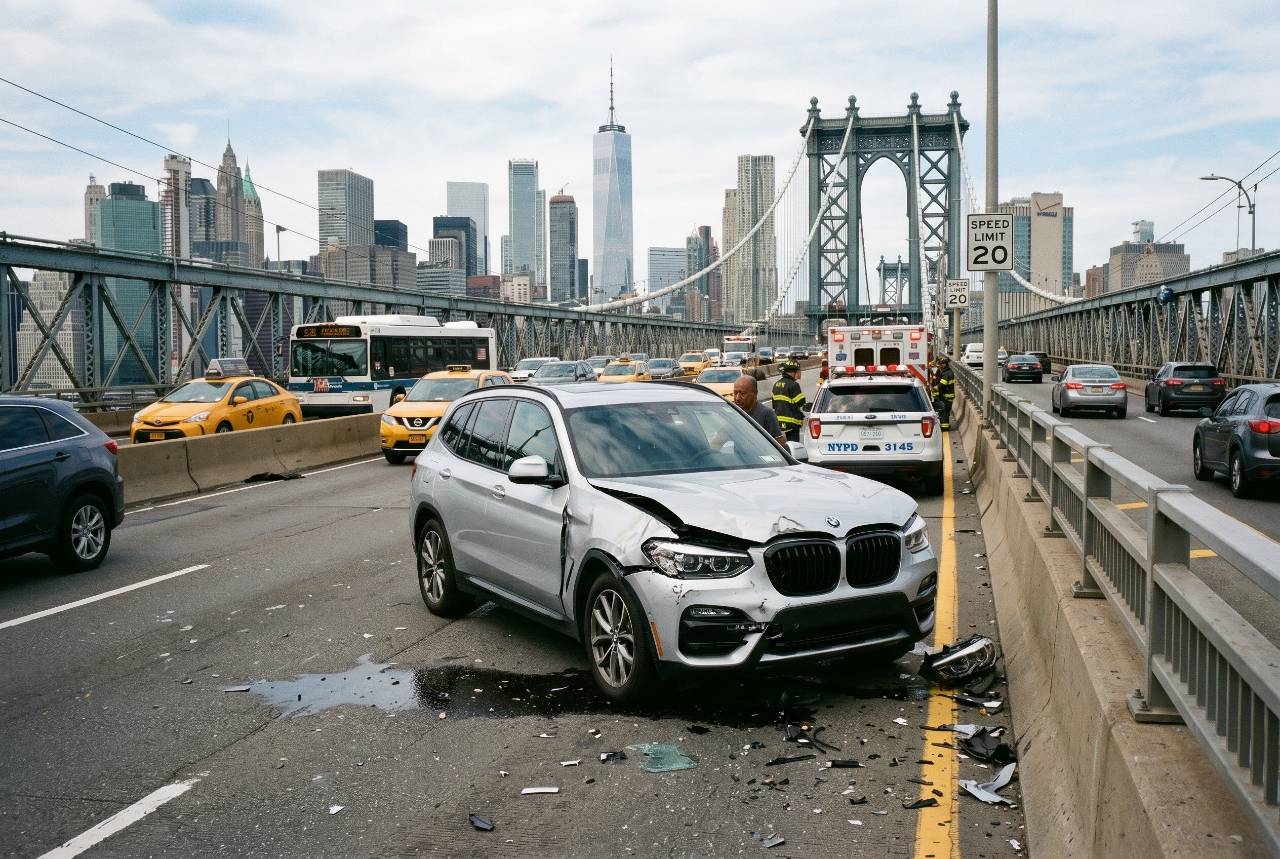
Lebedin Kofman LLP has been retained to defend a driver who faces multiple felony charges after a head-on collision on the 145th Street Bridge and the alleged disposal of a firearm into the Harlem River. The case, which drew significant media attention, involves overlapping gun charges, assault allegations, and DWI charges — a combination that raises the legal stakes considerably and demands an aggressive, multi-front defense strategy.
What Happened on the 145th Street Bridge
According to police reports and media coverage from the NY Daily News, the incident occurred in the early morning hours of August 15, 2021. A 34-year-old man was driving a BMW X3 SUV from the Bronx toward Manhattan when the vehicle reportedly veered out of its lane and collided head-on with a Nissan Altima traveling in the opposite direction. The impact demolished the front ends of both vehicles.
The 24-year-old Nissan driver sustained critical injuries and was transported to Harlem Hospital. The BMW driver suffered only minor injuries.
What elevated this case beyond a typical traffic collision was what police allege happened immediately after the crash. According to investigators, the BMW driver threw a firearm off the bridge and into the Harlem River. NYPD Harbor Unit scuba divers later recovered the weapon from the water. A 30-year-old woman and a 31-year-old man who were passengers in the BMW were also taken into police custody as officers worked to determine who the firearm belonged to — a direct consequence of New York’s automobile presumption law, which is discussed below.
The Charges Filed in This Case
The defendant faces a serious combination of felony and misdemeanor charges spanning three distinct areas of New York criminal law:
Criminal Possession of a Weapon in the Second Degree — Two Counts (Penal Law § 265.03)
The first count, charged under PL § 265.03(1)(b), alleges that the defendant possessed a loaded firearm with intent to use it unlawfully against another person. The second count, charged under PL § 265.03(3), alleges simple possession of a loaded firearm outside the defendant’s home or place of business. Both are Class C violent felonies. Under New York law, a conviction on either count carries a mandatory minimum sentence of three and a half years in state prison, with a maximum of fifteen years. For defendants with prior felony convictions, the mandatory minimum increases to five or seven years depending on the nature of the prior offense.
Assault in the Second Degree — One Count (Penal Law § 120.05(4))
This charge alleges that the defendant recklessly caused serious physical injury to another person by means of a deadly weapon or dangerous instrument — in this case, the vehicle itself. This is a Class D felony carrying up to seven years in prison. The prosecution must establish that the driver acted recklessly and that the other motorist suffered injuries meeting the legal threshold for “serious physical injury” under Penal Law § 10.00(10), which encompasses physical injury that causes death, creates a substantial risk of death, or results in protracted disfigurement, protracted impairment of health, or protracted loss or impairment of the function of a bodily organ.
DWI and DWAI Charges (VTL § 1192.2 and VTL § 1192.1)
The defendant was also charged with operating a motor vehicle with a blood alcohol concentration of .08% or greater under Vehicle and Traffic Law § 1192.2 (an unclassified misdemeanor) and driving while ability impaired by alcohol under VTL § 1192.1 (a traffic infraction). When DWI charges accompany felony weapon and assault charges, the alcohol-related offenses can significantly complicate plea negotiations and sentencing — even though the DWI charges themselves carry relatively lighter statutory penalties on their own.
Understanding the Gun Charges: Why Possession Matters Even Without Use
New York has some of the strictest firearms laws in the country, and simply possessing a loaded firearm outside your home or place of business — without a valid New York license — is a serious felony. There is no requirement that the defendant actually fired the weapon or threatened anyone with it. Under PL § 265.03(3), the mere knowing possession of a loaded firearm is enough.
What makes this case particularly complex is the fact that the firearm was allegedly disposed of before police could recover it from the vehicle. NYPD Harbor Unit divers ultimately retrieved it from the Harlem River, but the act of disposal itself creates additional legal exposure. Under Penal Law § 215.40, a person commits the Class E felony of tampering with physical evidence when — believing that physical evidence is about to be produced or used in an official proceeding — they suppress it through concealment, alteration, or destruction. While the formal charge sheet in this case does not list a tampering charge at the arraignment stage, the allegation of discarding the weapon is a fact that prosecutors can use to argue consciousness of guilt and could potentially form the basis for additional charges.
New York’s Automobile Presumption: Why the Passengers Were Also Arrested
One of the most significant legal doctrines in play here is New York’s automobile presumption, codified in Penal Law § 265.15(3). Under this statute, the presence of a firearm in an automobile — other than a stolen vehicle or a public omnibus — creates a rebuttable presumption that every occupant of the vehicle possessed the weapon. This is why the two BMW passengers — a 30-year-old woman and a 31-year-old man — were also taken into custody even though police were still investigating who the gun belonged to.
The automobile presumption allows, but does not require, a judge or jury to infer that all occupants knowingly possessed the weapon. There are three statutory exceptions: the presumption does not apply if the firearm is found on the person of one specific occupant, if the vehicle is being operated for hire (such as a taxi or rideshare), or if the weapon is a pistol or revolver and one occupant possesses a valid concealed carry license. This last exception is limited to pistols and revolvers specifically — it does not extend to other types of firearms, which could be significant depending on the weapon involved in a given case. Beyond these statutory exceptions, criminal defense attorneys can challenge the presumption by presenting evidence that a particular occupant had no knowledge of or access to the weapon.
In cases like this one — where the weapon was allegedly thrown from the vehicle rather than recovered inside it — the application of the automobile presumption involves an additional layer of legal argument. New York courts have addressed scenarios where a firearm is recovered outside a vehicle after being discarded, and the presumption may still apply depending on the specific facts and circumstances. An experienced defense attorney will scrutinize the timeline, witness statements, and physical evidence to challenge whether the presumption can properly be invoked.
The Reckless Assault Charge: When a Vehicle Becomes a “Deadly Weapon”
The assault in the second degree charge under PL § 120.05(4) is built on the theory that the defendant recklessly caused serious physical injury using a deadly weapon or dangerous instrument. In vehicular cases, the “weapon” at issue is the automobile itself. New York courts have consistently held that a motor vehicle can constitute a dangerous instrument when used in a manner that is readily capable of causing death or serious physical injury.
For this charge to succeed, the prosecution must prove that the defendant acted recklessly — meaning they were aware of and consciously disregarded a substantial and unjustifiable risk. The DWI allegations provide a potential basis for establishing recklessness, as operating a vehicle while intoxicated is inherently dangerous conduct. However, recklessness and intoxication are separate legal concepts, and a skilled defense attorney may challenge whether the evidence actually supports the required mental state.
It is also worth noting that the charge sheet references a “gun other than handgun” in connection with the assault count. This designation may relate to the type of firearm recovered, and it could affect the specific legal analysis under both the assault and weapon possession charges.
Potential Defense Strategies
Cases that combine firearms charges, vehicular offenses, and DWI allegations present multiple avenues for defense. While the specific approach depends on the facts as they develop through the discovery process, several general defense strategies may apply in situations like this:
Challenging the weapon possession charges. If there were multiple occupants in the vehicle, establishing who actually possessed or controlled the firearm becomes a central factual question. The defense may argue that the defendant did not knowingly possess the weapon and that the automobile presumption should not apply under the specific circumstances.
Contesting the assault charge. The prosecution must prove both recklessness and serious physical injury. If the Nissan driver’s injuries — while serious — do not meet the specific statutory threshold under PL § 10.00(10), or if the defense can present an alternative explanation for why the BMW crossed into the opposing lane, the assault charge may be vulnerable.
Examining the DWI evidence. DWI defense involves scrutinizing the administration and accuracy of chemical testing, the legality of the traffic stop (or in this case, the post-accident investigation), and whether proper procedures were followed in obtaining breath or blood samples. Challenges to the BAC evidence could also undermine the recklessness element of the assault charge.
Suppression motions. If the firearm was recovered through a search that lacked proper legal authority, or if statements were obtained in violation of the defendant’s constitutional rights, suppression motions under CPL Article 710 could significantly weaken the prosecution’s case.
Why Experienced Defense Counsel Matters in Multi-Charge Cases
Cases involving the intersection of gun charges, vehicular crimes, and DWI offenses are among the most complex matters in New York criminal defense. Each charge carries its own elements, potential penalties, and procedural requirements — and the charges can interact in ways that amplify the legal exposure well beyond what any single charge would carry on its own.
At Lebedin Kofman LLP, we have extensive experience defending clients facing serious weapon charges, including cases where gun possession felonies have been reduced or dismissed entirely. Our approach involves a thorough investigation of the facts, aggressive challenges to the prosecution’s evidence, and strategic negotiation when it serves our client’s best interests.
If you or someone you know is facing criminal charges involving firearms, assault, or DWI in New York, contact Lebedin Kofman LLP for a free consultation. View our case results to see examples of the outcomes we have achieved for our clients.
Frequently Asked Questions
What is the penalty for criminal possession of a weapon in the second degree in New York?
Criminal possession of a weapon in the second degree under Penal Law § 265.03 is a Class C violent felony. For first-time offenders with no prior criminal history, a conviction carries a mandatory minimum of three and a half years in state prison and a maximum of fifteen years. Defendants with prior felony convictions face higher mandatory minimums. The severity of this charge makes early legal representation critical.
Can all passengers in a car be charged with gun possession in New York?
Yes. Under the automobile presumption in Penal Law § 265.15(3), the presence of a firearm in a vehicle creates a rebuttable presumption that every occupant possessed the weapon. This means all passengers can be arrested and charged. However, the presumption is not absolute — it can be challenged through evidence showing that a specific occupant had no knowledge of or access to the firearm.
What does “recklessly causing serious physical injury” mean under New York assault law?
Under Penal Law § 120.05(4), a person commits assault in the second degree when they recklessly cause serious physical injury using a deadly weapon or dangerous instrument. “Recklessly” means the person was aware of and consciously disregarded a substantial and unjustifiable risk. “Serious physical injury” is defined in Penal Law § 10.00(10) as physical injury that causes death, creates a substantial risk of death, or that causes protracted disfigurement, impairment of health, or loss or impairment of the function of a bodily organ.
Can throwing away a gun after an accident lead to additional charges?
Potentially, yes. Under Penal Law § 215.40, disposing of physical evidence — including a firearm — to prevent its use in an official proceeding is the Class E felony of tampering with physical evidence. Even if this charge is not filed at the outset of a case, the act of discarding a weapon can be used by prosecutors to argue consciousness of guilt and may influence how the court views the defendant’s conduct.
How does a DWI charge affect a co-pending assault case?
A DWI charge can complicate an assault case because evidence of intoxication may be used by prosecutors to establish the recklessness element required for certain assault charges. Operating a vehicle while impaired creates a strong basis for arguing that the defendant consciously disregarded a substantial risk of causing injury. However, a DWI charge does not automatically prove recklessness, and skilled defense counsel can challenge the connection between the two.