
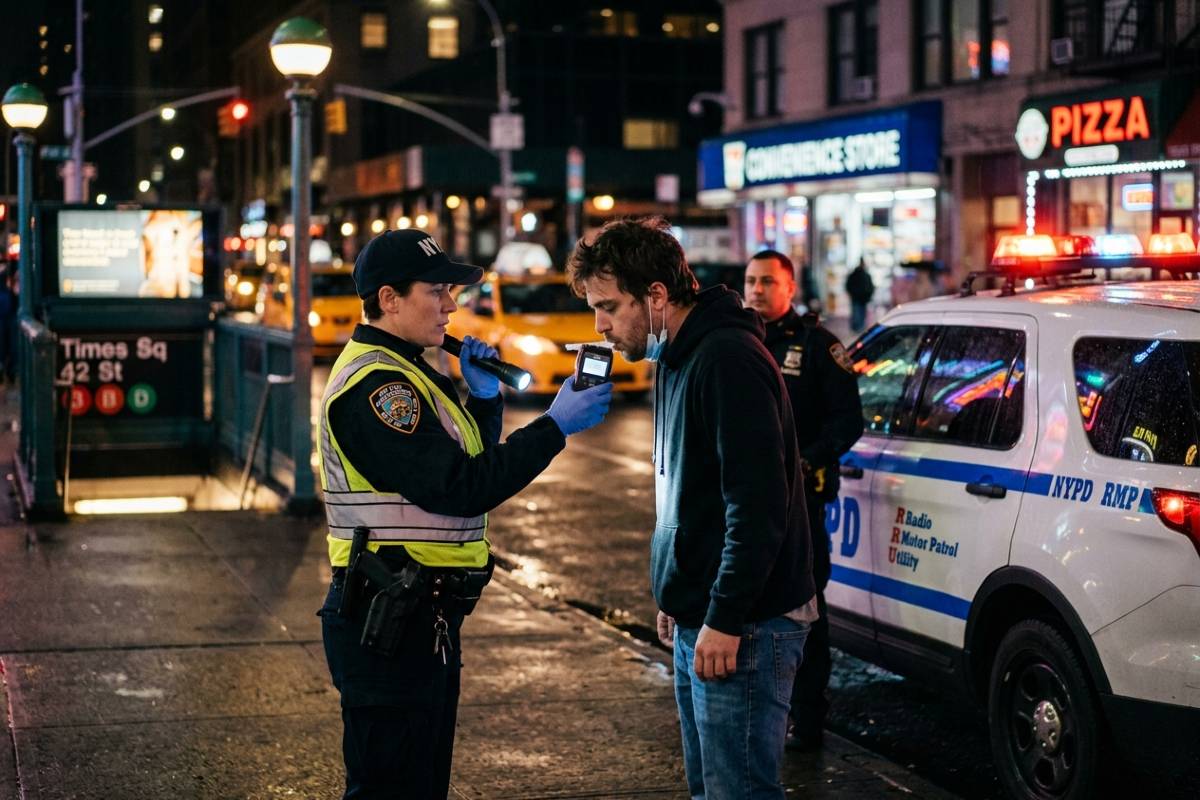
If your breathalyzer result came back at or just over the legal limit, your BAC may have still been rising at the time you were driving. Learn how the Rising BAC defense works under New York law and when it may apply to your case.
The Number on the Breathalyzer Is Not the Whole Story
Most people assume that a breath test result above 0.08% means an automatic conviction. That assumption is wrong.
Under New York law, the prosecution must prove that the defendant had a blood alcohol concentration at or above the legal limit at the time of driving — not simply at the time the test was administered. The New York Court of Appeals established this principle nearly four decades ago in People v. Mertz, 68 N.Y.2d 136 (1986), and it remains binding law today under the current 0.08% standard set by VTL § 1192(2).
In most DWI arrests, there is a significant gap — often 30 minutes to two hours or more — between when a driver is pulled over and when the breath or blood test is actually conducted. During that window, alcohol continues to be absorbed into the bloodstream. A person’s BAC can still be climbing well after they have stopped drinking and stopped driving.
This scientific reality creates the foundation for what defense attorneys call the Rising BAC defense: the argument that the defendant’s blood alcohol concentration was below the legal limit while driving and only exceeded 0.08% afterward, during police processing.
At Lebedin Kofman LLP, we represent clients facing DWI charges throughout New York City — including as a Manhattan DWI lawyer — and across Long Island, including as a Nassau County DWI lawyer and Suffolk County criminal lawyer. In this article, we explain the law, the science, and the practical mechanics behind the Rising BAC defense so you can understand whether it may apply to your case.
What the Law Actually Requires: BAC “At the Time of Operation”
The Per Se Standard Under VTL § 1192(2)
Under New York Vehicle and Traffic Law § 1192(2), it is a crime to operate a motor vehicle while having 0.08% or more by weight of alcohol in the blood “as shown by chemical analysis.” This is the “per se” DWI standard — guilt is based on the chemical test result, not on observed impairment alone.
The critical legal point is that the elevated BAC must have existed while the defendant was operating the vehicle, not merely at some later point during arrest processing or testing. Many defendants are also unsure about whether a DWI is a felony in New York — the answer depends on factors including prior convictions and the circumstances of the arrest.
The Landmark Case: People v. Mertz (1986)
In People v. Mertz — decided in 1986 when New York’s legal limit was 0.10% — the Court of Appeals held that a violation of the per se DWI statute is not established unless the trier of fact finds that the defendant had a BAC at the requisite level while actually operating a motor vehicle. That principle applies with equal force under today’s 0.08% standard.
The court ruled that evidence of a breathalyzer test administered within two hours of arrest showing a BAC at or above the legal limit is sufficient to establish a prima facie violation. However, the court also held that it is “error not to permit defendant’s attorney to argue” on the basis of evidence that the defendant’s BAC at the time of driving was actually below the legal threshold.
Mertz has been cited in thousands of subsequent cases and remains the foundational authority guaranteeing a defendant’s right to challenge whether a test result accurately reflected their BAC at the time of driving.
The Jury Instruction: Inference, Not Conclusive Proof
The New York Court System’s Criminal Jury Instructions (CJI2d) for VTL § 1192(2).pdf) make clear that evidence of a BAC at or above 0.08% “permits, but does not require, the inference” that the defendant had that BAC at the time of operation. The jury must consider the lapse of time between vehicle operation and the test, whether the device was in working order, whether the test was properly administered, and the qualifications of the officer who administered it.
VTL § 1195: The Statutory Presumptions
VTL § 1195 establishes the probative value of chemical test results in New York DWI cases. The statute creates a tiered framework: a BAC of 0.05% or less is prima facie evidence the driver was neither impaired nor intoxicated; a BAC above 0.05% but below 0.07% is prima facie evidence the driver was not intoxicated, though it remains relevant evidence on the question of impairment (DWAI); and a BAC between 0.07% and 0.08% is prima facie evidence of no intoxication but carries prima facie weight on impairment. A result at or above 0.08% establishes prima facie evidence of intoxication — but that evidence is rebuttable.
This rebuttable nature is precisely what creates the legal space for the Rising BAC defense. For more on this topic, see our discussion of whether laws address BAC levels below 0.08%.
The Science: How BAC Rises After Drinking
The Absorption Phase
After consuming alcohol, the body does not instantly register the full effect in the bloodstream. Alcohol is absorbed through the gastrointestinal tract, and blood alcohol concentration continues to rise for a period after drinking stops.
According to peer-reviewed research published through the National Institutes of Health, on an empty stomach, BAC typically peaks roughly one hour after consumption. On a full stomach, or when carbonated beverages are involved, absorption is significantly slower.
The degree of individual variation can be striking. A 2025 forensic pharmacology study published in a peer-reviewed journal documented cases where subjects did not reach peak BAC until approximately 230 minutes — nearly four hours — after finishing their drinks. The researchers identified a biphasic absorption pattern in which a portion of alcohol trickled into the bloodstream over several hours, cautioning that standard forensic calculations may not account for this variability.
The Elimination Phase
Once the body reaches peak BAC, it enters the elimination phase, where alcohol is metabolized primarily by the liver. The generally accepted elimination rate is approximately 0.015% to 0.020% per hour, though this varies widely among individuals. The average rate of elimination is roughly 15 mg per 100 ml per hour, but the normal population range spans from 10 to 20 mg per 100 ml per hour.
Why This Matters in a DWI Stop
A driver who consumed drinks shortly before or during driving may still be in the absorption phase — with BAC still climbing — at the time of a traffic stop. The breathalyzer or blood test, administered 30 to 90 minutes later, captures BAC at a higher point than existed while the driver was actually operating the vehicle.
This is precisely the scenario the Rising BAC defense addresses.
How the Defense Is Raised in Court
Step 1: Establish the Timing Gap
Defense counsel reviews the arrest record to identify the time of the traffic stop, the time of arrest, and the time the chemical test was administered. Understanding what happens after a DWI arrest is important context here — the larger the gap between the stop and the test, the stronger the potential defense argument.
Under VTL § 1194(2)(a), law enforcement must administer the chemical test within two hours of arrest. But even a test taken 45 minutes after the stop can create meaningful scientific distance between the BAC at the time of driving and the BAC captured by the test.
Step 2: Evaluate the Drinking Pattern and Timing
The defense must present a credible account of what the defendant consumed, when they consumed it, and whether food was involved — because absorption rates vary significantly based on these factors.
A defendant who consumed drinks in the 30 to 60 minutes before driving is a strong candidate for the Rising BAC argument. A defendant who stopped drinking hours earlier and had entered the elimination phase is not.
Step 3: Challenge Retrograde Extrapolation
Prosecutors often rely on a technique called retrograde extrapolation — a forensic calculation that works backward from a known post-arrest BAC to estimate what the defendant’s BAC was at the time of driving.
This calculation assumes the defendant was in the elimination phase (BAC declining) at the time of the test. If the defendant was actually still in the absorption phase, retrograde extrapolation produces a false result — it estimates the prior BAC as even higher than the test result, when in reality the BAC was lower while driving.
Defense counsel can challenge retrograde extrapolation on multiple grounds: the assumed elimination rate may not match the individual defendant; the absorption timeline was never established; and the model breaks down entirely if the defendant had not yet reached peak BAC.
Courts have held that unqualified witnesses — such as law enforcement officers without toxicology training — cannot offer retrograde extrapolation testimony. A qualified forensic toxicologist is required.
Step 4: Retain a Defense Expert
Because the Rising BAC defense hinges on pharmacokinetics, a qualified expert witness — typically a forensic toxicologist — is often essential to present the argument persuasively to a jury. Expert testimony is one of several elements that factor into how to win a DWI case in New York.
The expert can model the defendant’s absorption curve based on body weight, gender, drinking history, food intake, and the timing of consumption. Defendants may also exercise the right under VTL § 1194(4)(b) to request an independent chemical test administered by their own physician.
New York’s Testing Rules: Procedural Challenges That Reinforce the Defense
New York has strict regulatory requirements governing how breath tests are administered. When law enforcement fails to follow these rules, it creates additional grounds to challenge BAC evidence — grounds that often reinforce a Rising BAC argument. Understanding what should be considered when determining the accuracy of chemical test results is essential for anyone contesting a DWI charge.
The 15-Minute Observation Period
Under 10 NYCRR § 59.5, the New York Department of Health requires that a subject be observed for at least 15 minutes immediately before a breath test. During this period, the subject must not ingest any fluids, food, or tobacco, and must not vomit. If any of these events occur, an additional 15-minute observation period is required. Many practitioners and courts commonly refer to this as a “20-minute” observation period.
If the observation period is improperly conducted — if the officer left the room, looked away, or failed to restart the clock after a contaminating event — the breath test result may be suppressed entirely.
Approved Instruments Only
New York law requires that only breathalyzer instruments appearing on the Department of Health’s Conforming Products List under 10 NYCRR § 59.4 may be used for evidentiary purposes. The officer administering the test must also hold a valid permit issued by the Commissioner of Health under 10 NYCRR § 59.7.
A DOH permit creates a rebuttable presumption that the test was properly administered — but the defense may challenge that presumption.
The Second-Decimal Rounding Rule
Under 10 NYCRR § 59.5(e), breath test results must be reported only to the second decimal place. A reading of 0.087%, for example, must be reported as 0.08%.
This rounding rule has been directly litigated. In People v. Hernandez (2023 NY Slip Op 23302), a Bronx Criminal Court addressed a prosecution expert’s attempt to use a third decimal place in a retrograde extrapolation analysis — illustrating how this regulatory requirement can directly affect the scientific calculations used against a defendant.
The Two-Hour Rule
Chemical tests administered more than two hours after arrest carry significant admissibility and reliability questions. Under VTL § 1194(2)(a), courts have historically required expert testimony to establish that a late test is reliable evidence of BAC at the time of driving.
The two-hour rule underscores the fundamental tension in per se DWI prosecution: the test captures BAC at a different moment than the alleged offense.
Mouth Alcohol Contamination
Residual alcohol in the mouth — from recent regurgitation, dental work, or other causes — can produce a falsely elevated breath test reading. This is one of the reasons the observation period exists: to allow any residual mouth alcohol to dissipate before testing. When that period is found insufficient, courts have suppressed BAC results on this basis.
When the Rising BAC Defense Is Most Likely to Succeed
Factors That Strengthen the Argument
The Rising BAC defense tends to be strongest when several conditions align: the test result was close to the 0.08% threshold (for example, between 0.08% and 0.11%); significant time elapsed between the traffic stop and the test (45 minutes or more); the defendant consumed alcohol within 30 to 60 minutes of driving; the defendant ate food along with the alcohol, slowing absorption; the defendant’s driving behavior showed no obvious signs of impairment; field sobriety test results were equivocal or absent; and the defendant can document what they consumed and when.
Factors That Weaken the Argument
Conversely, the defense faces significant headwinds when the test result was well above 0.08% (for instance, 0.15% or higher — which enters Aggravated DWI territory under VTL § 1192(2-a)); the defendant’s last drink was more than one to two hours before driving, making an elimination-phase scenario more likely; obvious signs of impairment were observed at the scene; the defendant failed multiple field sobriety tests; or the defendant made statements about their drinking that are inconsistent with a rising BAC timeline.
The Common Law DWI Charge: An Important Caveat
Even if the Rising BAC defense successfully challenges the per se count under VTL § 1192(2), prosecutors may simultaneously charge common law DWI under VTL § 1192(3). This charge is based on observed signs of intoxication — slurred speech, poor coordination, erratic driving — and does not require a specific BAC number. The DWI penalties a defendant faces can be substantial under either theory of prosecution.
A successful Rising BAC defense must therefore be paired with a comprehensive case strategy that addresses behavioral evidence as well. It is also worth understanding the broader penalties for alcohol or drug-related violations in New York.
The Defense in Nassau and Suffolk County Courts
DWI cases on Long Island follow specific procedural tracks. In Nassau County, misdemeanor DWI cases are processed at Nassau County District Court in Hempstead, while felony matters are handled at Nassau County Court in Mineola. If you are looking for a Nassau County criminal lawyer, it is important to choose counsel who understands these local court systems. In Suffolk County, misdemeanor cases are heard in the District Courts at Central Islip and Hauppauge, with felonies prosecuted at Suffolk County Court in Riverhead.
Both the Suffolk County Police Department (SCPD) and the Nassau County Police Department (NCPD) are designated training agencies under 10 NYCRR § 59.1(d), meaning they operate their own certified breathalyzer training programs and are subject to the same Department of Health standards that underpin Rising BAC and breath test challenge arguments.
The New York State Department of Health’s Wadsworth Center, which administers the statewide breath and blood alcohol testing program under 10 NYCRR Part 59, is currently accepting public comment on proposed amendments to Part 59 — a development that could carry future legal significance for DWI defense.
Long Island’s suburban geography also matters. Residents typically drive to and from social events rather than using public transit, which means DWI cases on Long Island frequently involve the exact fact pattern where the Rising BAC defense applies: drinks at a restaurant or bar, followed by a drive home, followed by a stop en route or shortly after arrival.
How This Interacts With the Implied Consent Law
Under VTL § 1194(2), every person who operates a motor vehicle in New York is deemed to have given implied consent to a chemical test. Refusing the breath or blood test after a lawful DWI arrest triggers immediate license suspension and, following a DMV hearing, potential revocation — plus a civil penalty — regardless of whether the underlying DWI charge is ever proven. Understanding how refusing a DUI test can affect your license is critical to making an informed decision.
Refusal evidence is also admissible at trial, where the prosecution can argue consciousness of guilt if proper warnings were given and the refusal was persistent.
This creates a genuine strategic dilemma for someone who believes their BAC was still rising and that the test would capture an elevated result. Refusing avoids creating per se evidence but generates a separate set of serious consequences.
There is also a counterintuitive strategic upside to compliance: a test result just above 0.08% is actually better for a Rising BAC defense than a refusal, because the relatively low number is consistent with the absorption scenario. A defendant whose driving was entirely normal and whose BAC came back at 0.09% may have a stronger overall defense position than one who refused testing entirely.
This strategic calculation requires early consultation with experienced DWI defense counsel.
Practical Takeaways for Someone Facing a DWI Charge
If you have been charged with DWI in New York and believe the Rising BAC defense may apply to your situation, there are several steps to take immediately.
Write down everything you can remember about the timeline: what you drank, how much, over what time period, whether you ate, what time you finished your last drink, and what time you were pulled over. Preserve any receipts, restaurant checks, or timestamped records of alcohol purchases. Note the exact times of the traffic stop, arrest, and breathalyzer test from any documentation you receive.
Do not discuss the details of your drinking with the arresting officer. There are important reasons why you should never admit to the police about drinking alcohol. Invoke your right to counsel. It is also important to be aware of common mistakes after a DWI arrest that can undermine your defense.
It is important to understand that the Rising BAC defense is not a simple “I only had a few drinks” argument. It requires scientific analysis of the specific absorption timeline, often supported by qualified expert testimony, and a precise legal strategy that addresses both the per se charge and any behavioral evidence the prosecution may present.
The defense is fact-specific. Whether it applies to a particular case depends on the gap between driving and testing, the test result, the drinking timeline, and the physical evidence — all factors that a qualified DWI defense attorney will evaluate in detail.
Contact Lebedin Kofman LLP
The science of alcohol absorption means that a breathalyzer result above 0.08% does not automatically prove guilt in a New York DWI case. Since People v. Mertz in 1986, New York courts have recognized that defendants have the right to challenge whether the test result reflects their BAC at the time of driving.
The Rising BAC defense, when the facts support it, is a legitimate and legally grounded strategy — not a loophole, but a reflection of how New York DWI law actually works.
At Lebedin Kofman LLP, our DWI defense attorneys represent clients facing charges throughout New York City and Long Island, including Nassau County and Suffolk County. If you were arrested for DWI and believe your BAC was still rising at the time of your stop, contact our office for a confidential consultation. You can also review our case results and learn more about the ramifications of pleading guilty to DWI before making any decisions about your case.
This article is for educational purposes only and does not constitute legal advice. Laws may change, and outcomes depend on individual facts and circumstances. Please consult a qualified attorney.